
The Earliest Swansea Town Football Cards
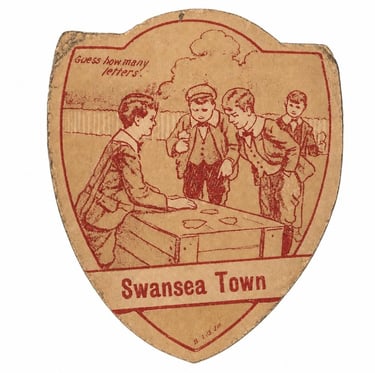
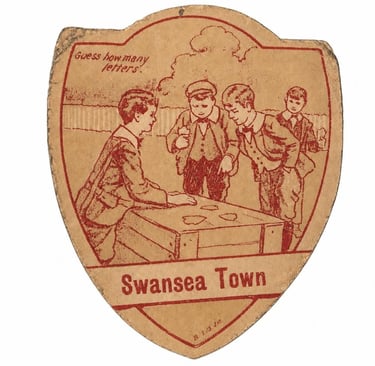
Swansea Town was founded in 1912, and the club's earliest known football cards are the shaped Baines issues, the first of which date to c.1912, the club's inaugural year. These were produced while Swansea were still competing in the Southern League.
After Swansea joined the Football League in 1920, the club and its players appeared in cigarette and trade card sets from manufacturers including Godfrey Phillips, Gallaher and John Player.
The Baines represent the Southern League years, while the 'Pinnace' and the cigarette and trade cards issued during the 1920s cover the Football League era. Together they form the foundation of an early Swansea Town collection.
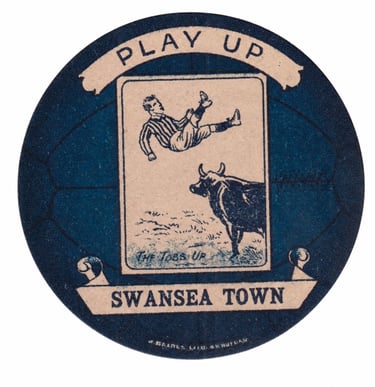
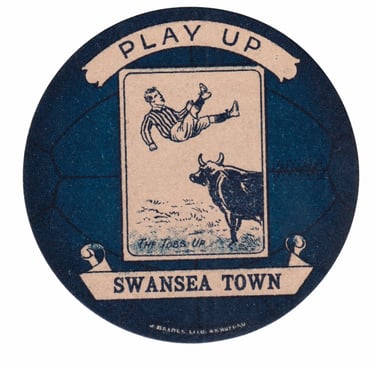
1912-1922 J. Baines


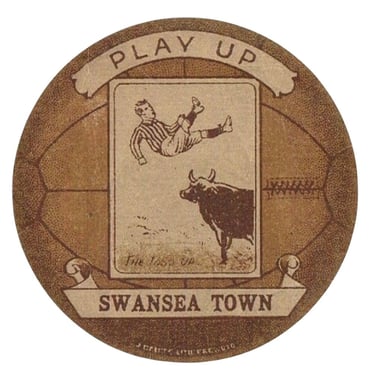
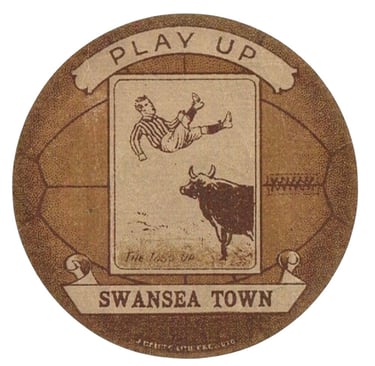
J. Baines of Bradford was a pioneering figure in British football card production, and its shaped issues rank among the earliest and most historically important football collectables ever produced.
At least four distinct J. Baines Swansea Town designs are currently known, but the true number is almost certainly higher.
One design stands apart from the rest. A shaped Baines card dated c.1912 is the only card currently known from the year Swansea Town was formed, which makes it the earliest recorded issue of any kind for the club. No others are known to exist in card form from the founding year, so it marks the true starting point of the Swansea Town card chronology.
Baines produced a vast and poorly documented range of shaped football cards, with no surviving complete checklist, so the total number of Swansea Town issues and variations remains unknown.
Differences in shape, illustration, wording, colour and back design mean further Swansea examples are likely still to exist. The Baines address imprint on the reverse, which changed as the company moved premises, is the main means of narrowing the date of any individual card.
1920–23 Godfrey Phillips 'Pinnace'
Godfrey Phillips’ ‘Pinnace’ Footballers series was one of the largest and most ambitious football-card issues produced in Britain, recording thousands of players from clubs across the country during the early 1920s.
At least 20 Swansea Town players are known in the numbered series, with several appearing in different printings, back styles and card sizes. The standard small cards were issued in cigarette packets, while larger formats could be obtained through a redemption scheme.
Swansea Town cards are known in small, medium and cabinet formats, alongside a scarce landscape team photograph. The cabinet team card is the outstanding Swansea issue from the series and one of the most desirable early cards connected with the club.
With 2,462 numbered subjects and 3,151 currently catalogued cards when recognised variations are included, completing even the Swansea Town run is a considerable challenge. Differences in size, back design, framing, printing and team details mean that the number of distinct Swansea examples is far greater than the basic player checklist suggests.
If you want to learn more about 'Pinnace', I highly recommend visiting https://pinnacecards.wordpress.com/an-introduction/ for more information. It's a huge resource on Pinnace cards.
The First ‘Pinnace’ Issue: Oval Backs
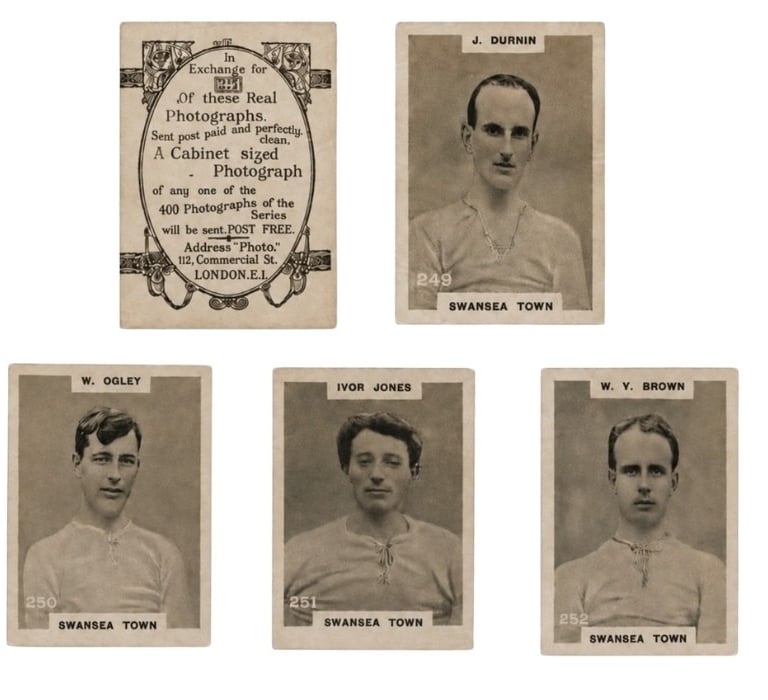
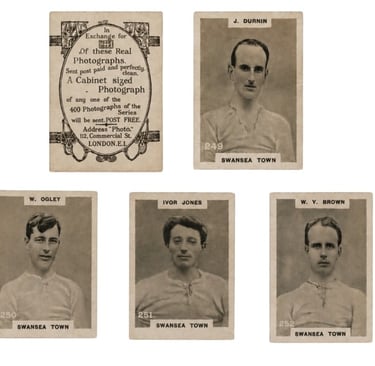
The earliest Godfrey Phillips ‘Pinnace’ football cards were issued with a distinctive oval design on the reverse.
These cards are particularly important to Swansea collectors because they are the first known cards to depict individual Swansea Town players.
Four Swansea players are currently known with the oval back: Durnin, Ogley, Ivor Jones and W. V. Brown. Ivor Jones is particularly important; he became the first Swansea Town player to represent Wales.
1920 - 1st Series Small (KF) Sized Cards with 'Oval Backs'
2nd Series Small (KF) Sized Cards with 'Double Framed' Backs
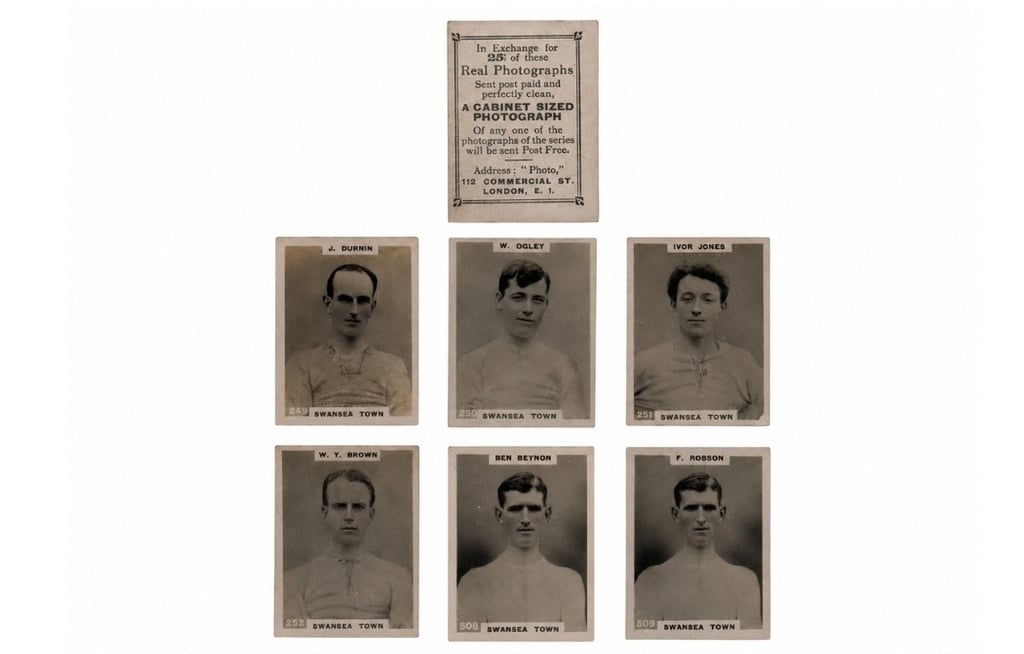
3rd Series Small (KF) Sized Cards with 'Photo' Backs
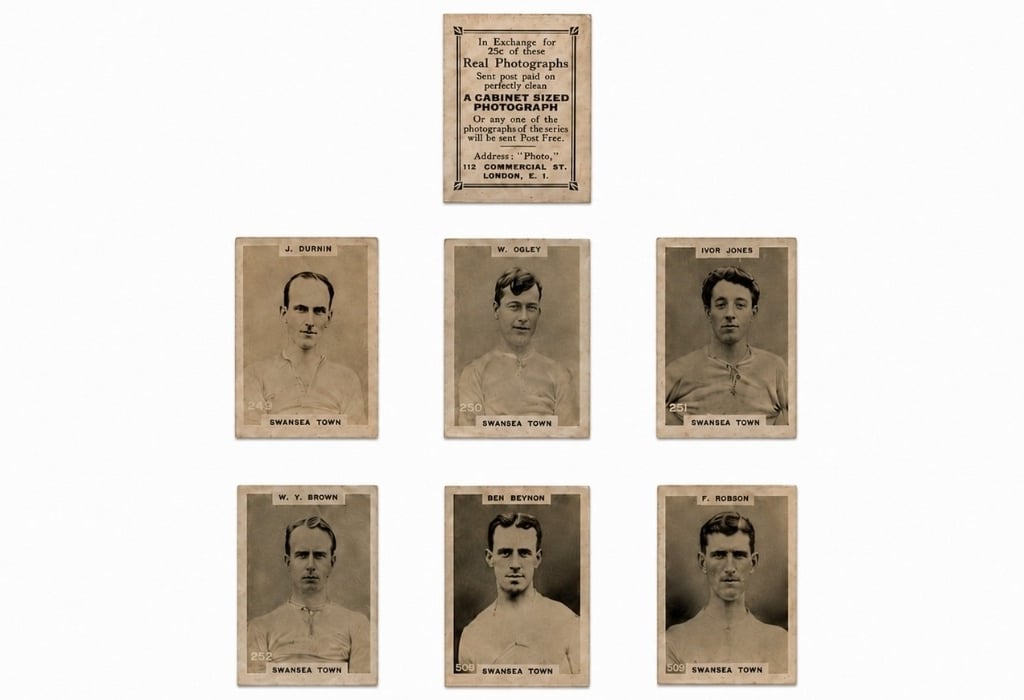
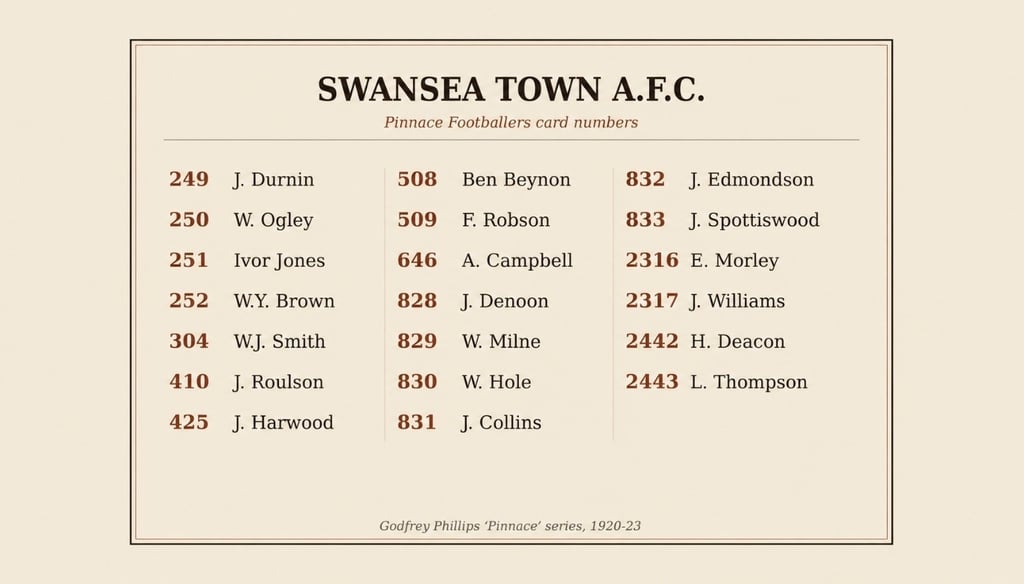
The full list of the small 'KF' card numbers is:
c. 1920 Godfrey Phillips Football Club Colours Silks
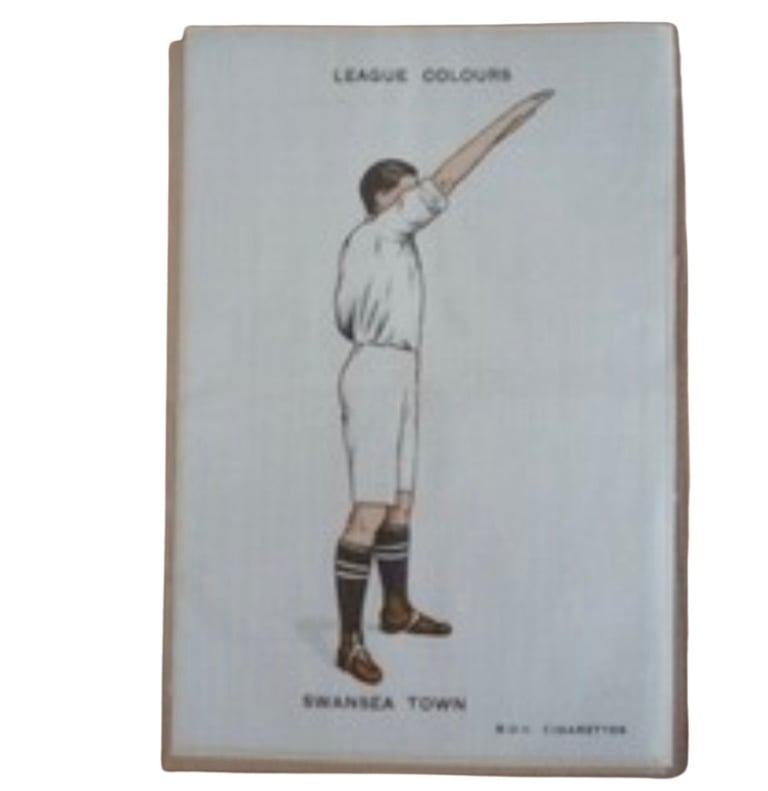
The 1920 Godfrey Phillips Ltd. / B.D.V. Cigarettes Football Club Colours silks were issued as a B.D.V. Cigarettes premium, with ninety known subjects in the series.
These comprise 63 association football clubs, 26 Rugby League clubs and county sides, and a generic Goalkeeper design.
Two sizes were issued, with the large measuring 150mm x 100mm and the small measuring 67mm x 47mm. The silks were redeemed against B.D.V. coupons rather than packed inside cigarette packets.
Swansea Town is one of the 63 football clubs represented in the set. The silk was produced in the same year the club entered the Football League's new Third Division, and is likely the earliest Swansea Town collectible produced in textile form.
The player is captured taking a throw in.
1923 Pluck Famous Football Teams
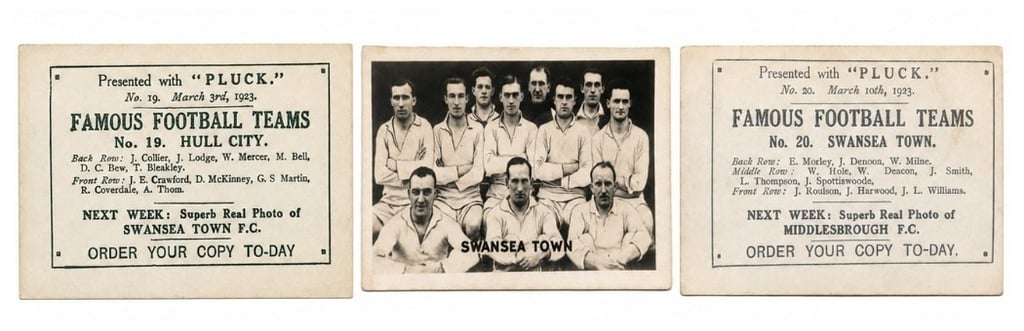
Pluck was a weekly boys' story paper from the Amalgamated Press, the Harmsworth house that led the market in popular boys' periodicals from the 1890s onwards. Like several rivals, it lifted sales in the early 1920s by giving away collectable cards, and the 1922–23 Famous Football Teams series was one such promotion: twenty-seven cards, one club a week from October 1922 to April 1923.
Each card carried a team group photograph on the front and, on the back, an announcement of the club due to appear the following week, a neat marketing device that gave readers a reason to buy the next issue. It exists in two parallel runs, an English and Welsh version and a scarcer Scottish one.
Swansea Town appear as card number twenty, dated 10 March 1923, in both runs, trailed the previous week on the back of the Hull City card of 3 March.
It is one of the earliest nationally distributed cards to feature the club, which had only recently been elected to the Football League.
The front and date are common to both versions, so the only difference lies on the reverse: the English and Welsh issue name Middlesbrough as next week's subject, while the rarer Scottish issue names Aberdeen.
1923 Adventure Gallery Famous Club Colours
"Famous Club Colours & Players" was issued in 1923 by D.C. Thomson through its boys' story paper Adventure.
Rather than printed cards, the figures were given away as sheets of nine inside consecutive weekly issues across the spring of that year, with collectors cutting the individual players from the sheets, which is why surviving examples are on thin paper and often show trimming.
The set is a large one, running to well over a hundred subjects, and its selection is notably broad, taking in lower-division and Scottish clubs such as Alloa Athletic, Stalybridge Celtic and Clyde alongside the major First Division names.
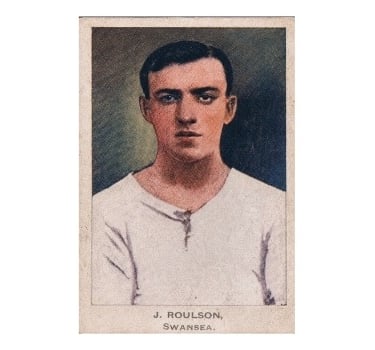
For Swansea Town the set includes J. Roulson, on the sheet dated 5 May 1923. This is Joe Roulson, a Sheffield-born right half who had won a Second Division title with Birmingham in 1920-21 before moving to Swansea Town, an experienced name also pictured in the contemporary Pinnace series

1923 J.C. Battock Cricket and Football Cards
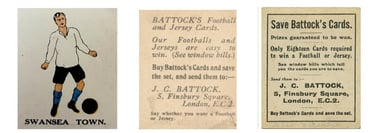
J.C. Battock was an importer and manufacturing confectioners' agent based at 5 Finsbury Square in the City of London in the early 1920s.
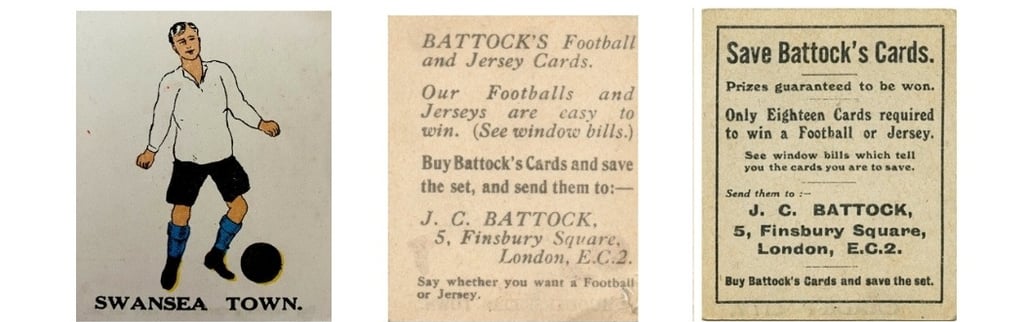
The cards weren't a product in themselves: in exchange for collecting them you could claim footballs and jerseys, making this an advertising-and-premium scheme rather than a tobacco or confectionery insert. The first series, "Cricket & Football Cards," dates from 1923, with the medium-sized cards (about 70mm by 57mm) covering both cricket and football subjects.
The backs state there are 108 different cards, though 109 are now known, and several teams exist with shirt variations. The set is genuinely rare, described as scarcer than the famous Baines cards of the Victorian and Edwardian period.
A full illustrated checklist can be found at https://1920sheaven.wordpress.com/cricket-and-football-cards/.
Swansea Town appears in the set as one of the football club cards, with an example pictured below, with two of the four known backs.
1923 Crescent Confectionery's Footballers
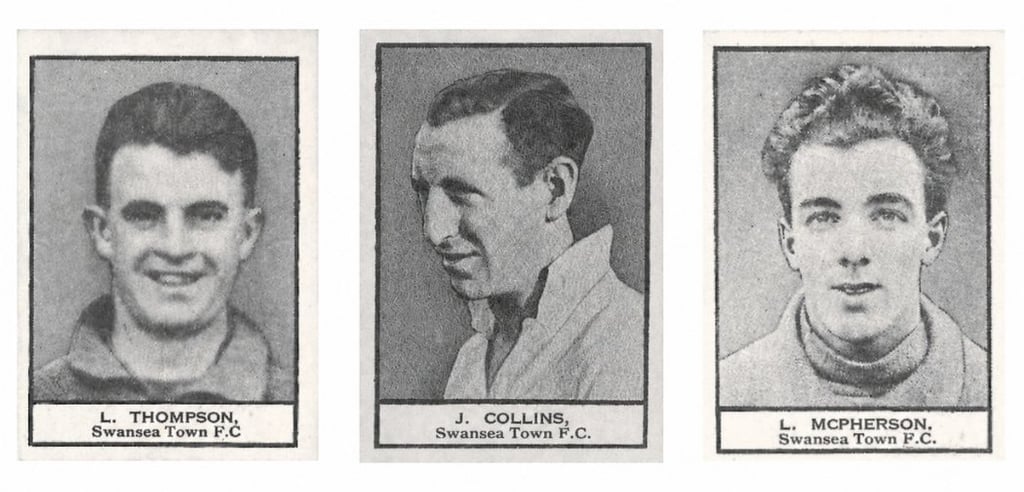
The Crescent Confectionery Company issued its "Footballers" series in the early 1920s, given away with its sweets.
Although dealers often date it to 1928, the presence of Danny Shea, whose only season at Coventry City was in 1923-24, more accurately places it in 1923.
The cards are small, around 55mm by 37mm, printed in black and white with a common back and no numbering. It is among the rarer and more sought-after confectionery issues of its day. A full checklist, with most of the cards illustrated, is available.
Swansea Town are represented by three players:
J. Collins
L. McPherson
L. Thompson
1924 Bucktrout
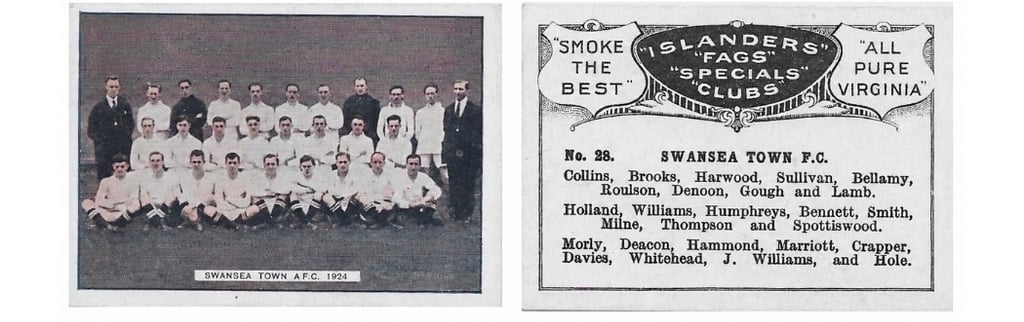
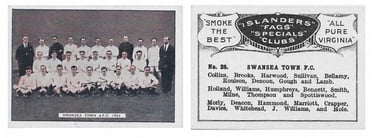
The 1924 Bucktrout Football Teams set was issued by Bucktrout & Co. Ltd. of Guernsey under their Islanders Fags cigarette brand. Fifty colour-tinted team group photographs cover Football League clubs across all three divisions, with most cards dated 1923-24 or 1924 on the front.
Swansea Town appear in the set, with the card dated 1924 on the front and showing a team group photograph from the club's fourth season in the Football League.
Manager Joe Bradshaw's side finished mid-table in the Third Division South that year, but the foundations were in place for the championship-winning campaign that followed in 1924-25.
1925 F.M. Foods Welsh Footballers, Rugby Players and Cricketers
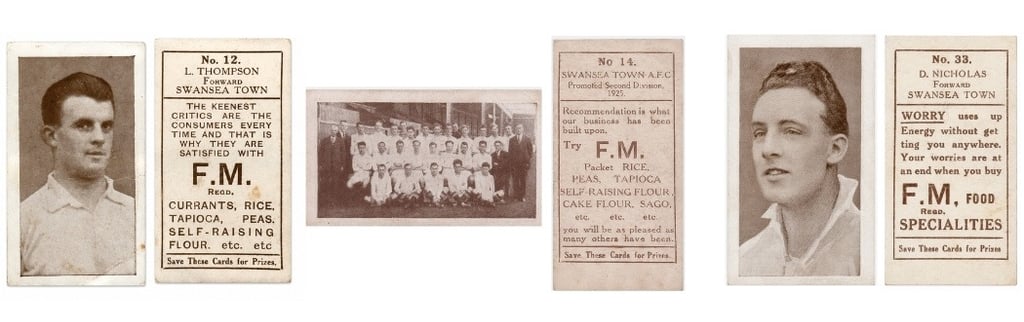
The 1925 F.M. Foods set is a scarce Welsh trade-card issue, produced by F.M. (Fred Morgan) Foods and distributed in South Wales as "Welsh Footballers and Cricketers," comprising 40 cards.
It is "vari-backed," each card carrying a different reverse advertising the company's foods, and its subject matter mixes Football League players with Welsh rugby men and a cricketer.
For a Swansea Town collector, it is especially rich, carrying seven of the club's men plus the team group. The cards are:
12 - L. Thompson
13 - Harry Deacon
14 - Swansea Town FC
16 - J. Fowler
17 - E. Morley
20 - W. Hole
33 - D. Nicholas
39 - Herbert Bellamy
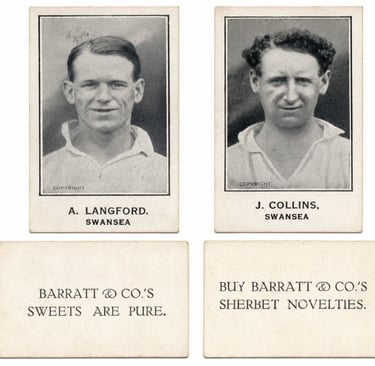
1925–28 Barratt "Cricketers, Footballers and Football Teams"
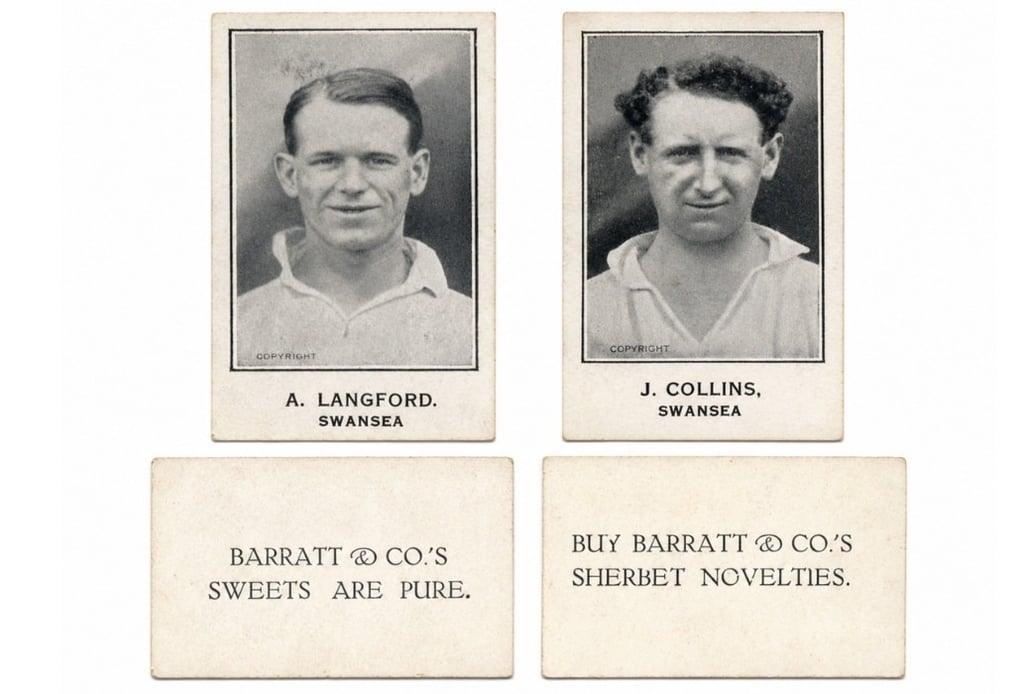
Barratt & Co. issued their "Cricketers, Footballers and Football Teams" series over several years rather than in a single season. Though it is often labelled simply as 1925, the run actually stretches from 1925 to 1928, a span that can be pinned down from players whose transfers between clubs only make sense across those years.
It is a large set, well beyond two hundred cards, printed unnumbered on small standard-sized cards of roughly 60mm by 35mm.
Collectors prize it partly for its complexity: the backs come in five distinct types, and most footballers appear on two or three of them, so building a complete run is a considerable undertaking.
A glossy cream-card version has also come to light, now thought to be a set of unique proofs.
A full checklist of players and their backs, with many, though not all, of the cards illustrated, can be found at https://1920sheaven.wordpress.com/cricketers-footballers-and-teams/.
Swansea Town are represented by five players across the series:
J. Collins
A. Deacon
A. Langford
W. Milne
J. Roulson
Several of these names recur throughout the club's mid-1920s card appearances, with Deacon, Milne and Roulson all turning up in other issues of the same period, making the set a natural companion to the other Swansea cards of the decade.
The 1925 Lacey's Chewing Wax Footballers
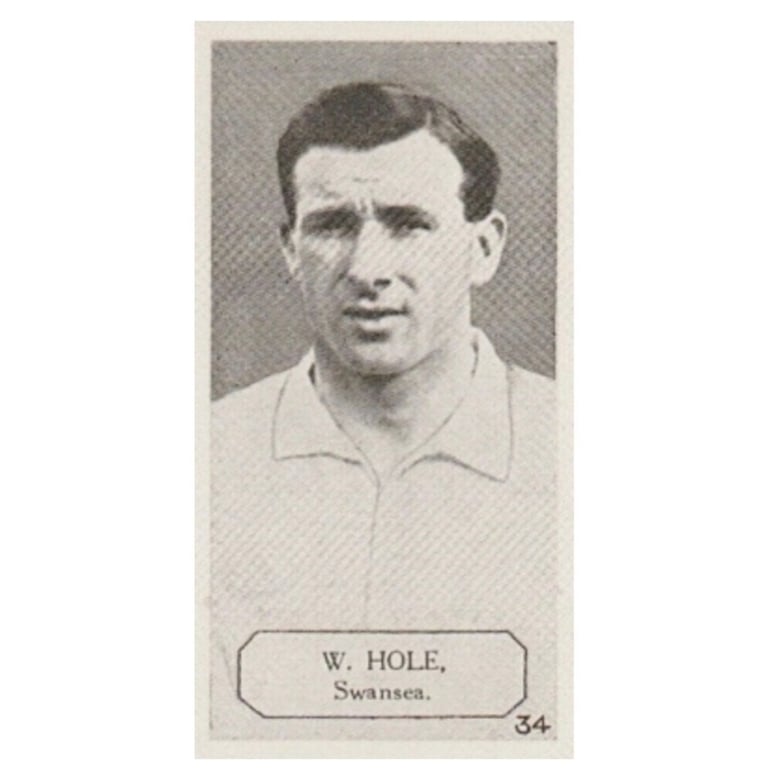
The 1925 Lacey's Chewing Wax Footballers set was issued by Lacey's Chewing Wax. Fifty numbered single-player portrait cards make up the series, each measuring approximately 69mm x 35mm, and the set is usually dated to 1925, though some catalogues list it as 1923.
Two back designs exist, one reading "Lacey's Chewing Wax" and the other "Lacey's Chewing Wax and Chewing Gum". The set was reprinted in the early 2000s as "The Nostalgia Classic Collection (Limited Edition)", with the reprint clearly identified by text along the bottom of the card back.
Swansea Town is represented by a single card, number 34, showing W. Hole.
Billy Hole was Swansea-born and signed for the club in 1919 during their Southern League days, going on to make 341 league appearances over 11 seasons and winning 9 caps for Wales. Billy Hole was the second Swansea player to play for Wales.
Two of his sons, Alan and Barrie, later made league appearances for Swansea Town.


1926 Ogden's Captains of Football
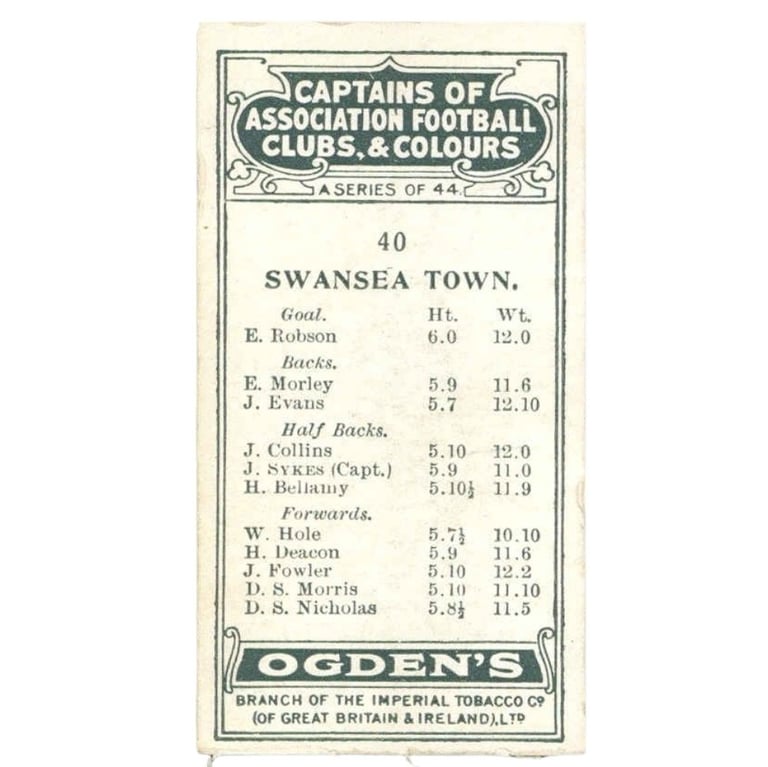
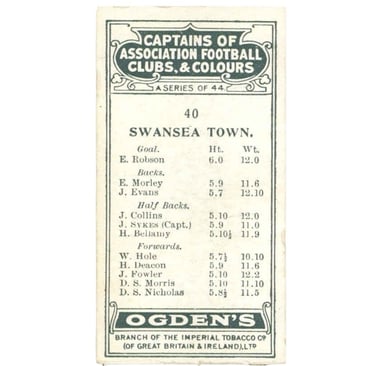
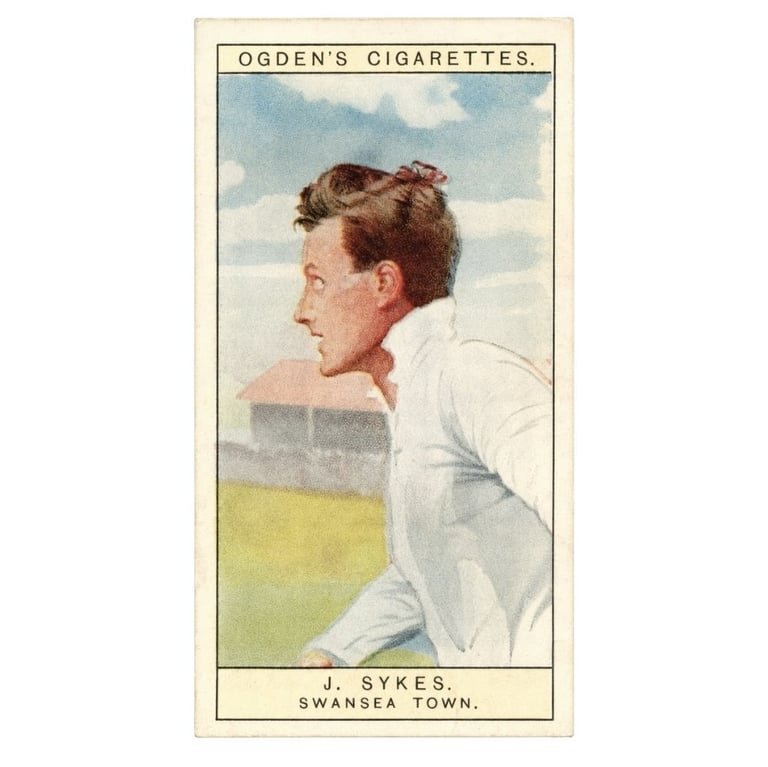
The 1926 Ogden's Captains of Association Football Clubs, & Colours set was issued by Ogden's Cigarettes and marked their return to football after a 16-year absence following the 1910 Football Club Badges set.
Forty-four numbered cards make up the series, each measuring approximately 36mm x 68mm, with full-colour painted artwork on the front and descriptive text on the back.
Each card shows the captain of a selected Football League club from the 1925-26 season, covering the First Division, Second Division and Third Division (North and South).
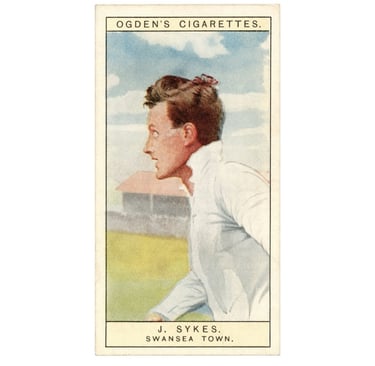
Swansea Town is represented by card 40, J. Sykes. Joe Sykes joined Swansea from Sheffield Wednesday in the summer of 1924, became club captain in his first season, and led the side to the Third Division South championship in 1924-25.
The Ogden's card depicts him during the following season, in which he also captained Swansea to their first ever FA Cup semi-final, where they lost 0-3 to eventual winners Bolton Wanderers at White Hart Lane on 27 March 1926.
Sykes went on to make 314 Football League appearances for the club and later returned as trainer, scout and caretaker manager. He spotted Ivor Allchurch in 1944 while scouting an under-18 game at Cwm Level Park.
1926 Amalgamated Press "Famous Footer Internationals"
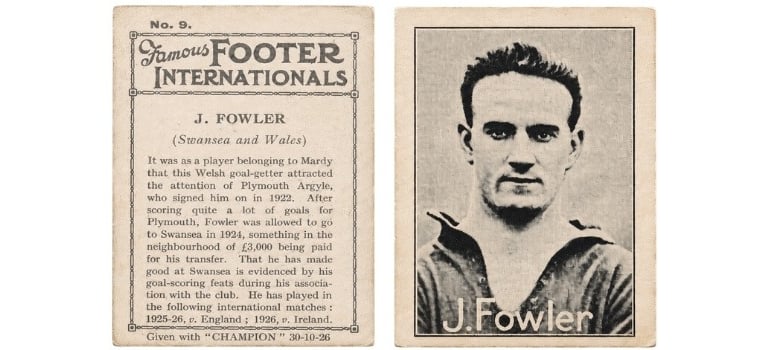
Issued in 1926, "Famous Footer Internationals" was a 24-card set given away with two of Amalgamated Press's boys' papers, Champion and Triumph.
The cards were split between the two titles, with one card issued with Champion and another with Triumph each week from 25 September to 11 December 1926, so two new cards appeared across the two papers every Saturday throughout the autumn.
Measuring 76 × 51mm and printed in black and white, each card carries a player portrait on the front and a short biography on the reverse.
The line-up gathers the leading internationals of the day, among them Hughie Gallacher, Alan Morton, Sid Puddefoot and Fred Keenor, drawn from across England, Scotland, Wales and Ireland.
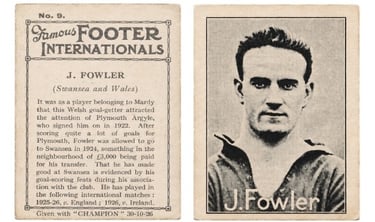
The Swansea Town entry is card number 9, J. Fowler, listed as "Swansea and Wales" and issued with Champion on 30 October 1926. This is Jack Fowler, the Cardiff-born centre-forward signed from Plymouth Argyle in 1924, who became a Vetch Field hero and scored more than 100 league goals for the Swans, including five in a single match when Swansea beat Charlton Athletic 6–1 on 27 September 1924.
He won six caps for Wales, his finest international moment coming in March 1926 when he scored twice in a 3–1 win over England at Selhurst Park, only months before this card appeared.
Fowler was the fourth Swansea player to appear for Wales.
1926 Gallaher Famous Footballers (Brown)
1927 John Player & Sons Football Caricatures By Mac
1928 John Player & Sons Footballers
1928 Gallaher Footballers Red Back
1928 Gallaher Footballers in Action
1928 Barratt Football Stars
Global Jacks
Connecting passionate Swansea City supporters worldwide.
GlobalJacks@scfc.co.uk
© 2025. All rights reserved.